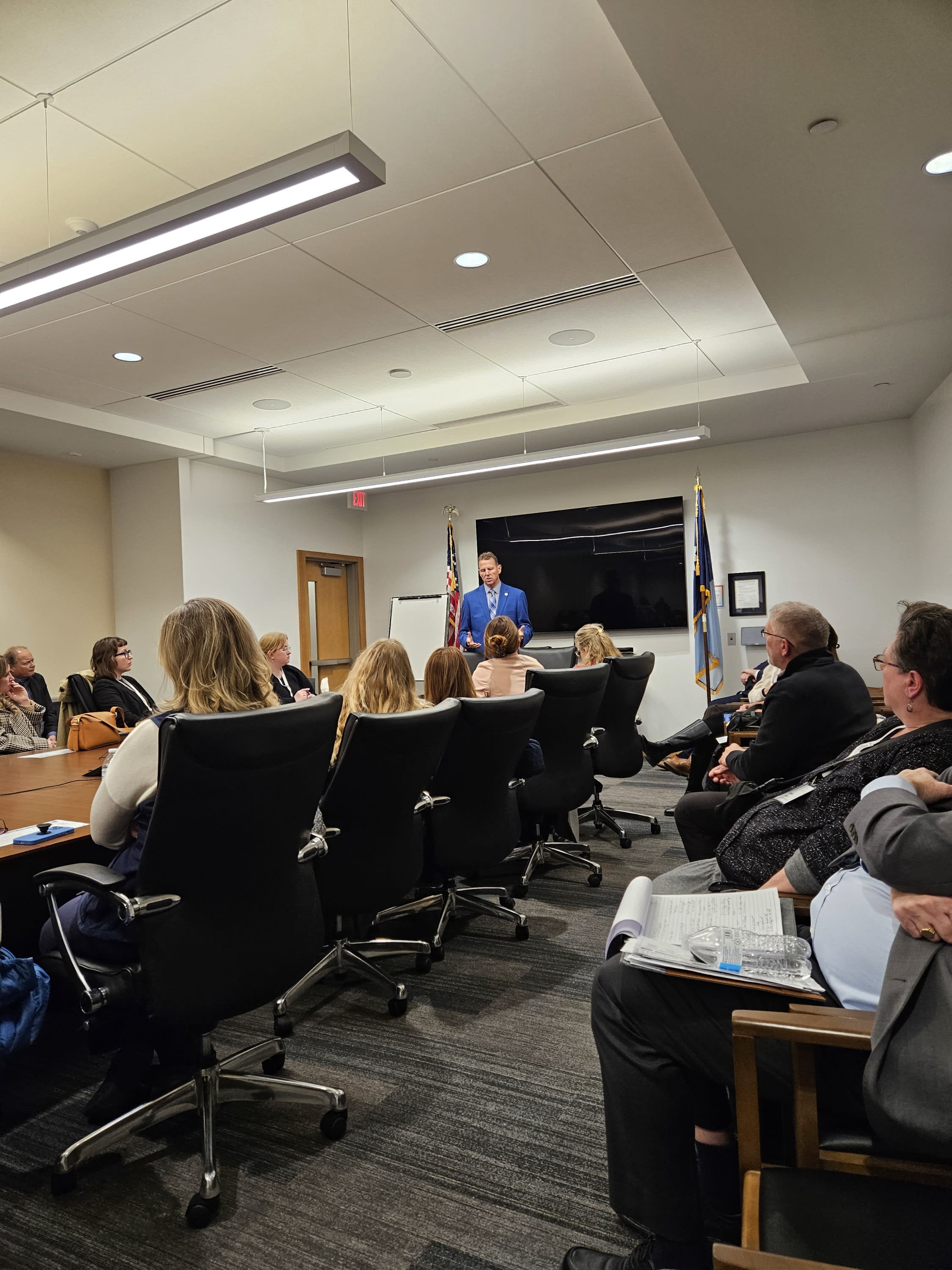
One theme kept surfacing across multiple sessions: Minnesota’s population is not refilling at the rate it once did. Whether we’re talking about 15–19 year olds leaving and not returning, or fewer new residents migrating in to replace them, the math simply isn’t working in our favor. The pipeline that once replenished our workforce and communities isn’t flowing at the same pace.
Postsecondary partners shared that large employers are pulling back from hiring straight out of college. Employers confirmed it. Many graduates are arriving without the soft skills, professional readiness, or applied experience that would outweigh the efficiency of emerging AI tools in entry-level roles. That gap creates a ripple effect. Students struggle to find meaningful work. Employers struggle to find ready talent. And when opportunity feels uncertain, people leave — or choose not to come at all.
This isn’t just a youth issue. It’s a population sustainability issue.
And yet — Minnesota remains an outlier in some powerful ways.
Myles Shaver’s presentation on our headquarter economy was a reminder that we are quietly exceptional. Emphasis on the quietly. While headquarters in other midwestern states migrate southwest, Minnesota has held strong. Recruiters shared something fascinating: it can be difficult to recruit talent to Minnesota — but once people are here, it’s almost impossible to get them to leave.
Why?
Not just economics.
Our public education system is strong — so strong that 86% of top managerial and C-suite talent send their children to public schools over private schools. We rank #1 nationally in dual-professional households. Our airport accessibility is a competitive advantage. Leisure and quality of life matter. And the number one factor cited in quality-of-life surveys — both before and after 2020 — remains safety.
Minnesota doesn’t rely on one defining industry. We’re not Detroit with cars. We’re medtech, food and ag, innovation, startups, advanced manufacturing — diversified and resilient. We also have a rare concentration of top managerial talent. Those leaders move across industries, elevate performance standards, and often transition into smaller startups where they raise the bar, strengthening our broader business ecosystem.
The strength is real.
The concern is that without population refill — without young professionals staying, without new residents moving in — even the strongest ecosystems eventually strain.
Another strong message from the conference was the evolving role of chambers in moments of instability. From civic unrest to workforce disruption to economic uncertainty, chambers are increasingly being called upon not just to host events, but to anchor recovery. The advice was clear: no more reactivity — focus on recovery. Communities that proactively build coalitions between city leadership, schools, police, chambers, nonprofits, and major employers are better positioned when disruption hits. Stability isn’t accidental. It’s structured.
And then there was the marketing reminder we all probably needed: learn to brag.
In a world of information overload, membership fatigue, and event saturation, chambers cannot afford to be modest about their impact. We are influencing deals. We are supporting workforce alignment. We are building leadership pipelines. We are strengthening civic infrastructure. Membership is not about attending a networking breakfast. It is about investing in economic resilience.
And that resilience doesn’t exist in isolation.
It shows up in how we attract and retain talent.
It shows up in how we stabilize businesses during disruption.
And it shows up in something we sometimes underestimate: who is coming to visit.
Because economic vitality doesn’t begin the day someone signs a lease or accepts a job offer. It often begins much earlier — when someone first experiences a community.
That’s where tourism enters the conversation — not as fluff, but as infrastructure.
One tourism leader shared a statistic that reframed the conversation even further: without tourism dollars, the average family would pay over $1,000 more per year in taxes. And for every $1 spent in tourism, $7 returns to the community. “It all starts with a visit,” she said.
A visit can become a relocation.
A relocation can become a business investment.
A business investment can become generational stability.
Population sustainability, executive retention, workforce readiness, tourism economics — they are not separate conversations. They are interconnected levers in the same system.
Kat Perkins closed the conference with a simple question: What would you do if you weren’t afraid?
If we weren’t afraid to rethink workforce pipelines.
If we weren’t afraid to boldly tell our community’s story.
If we weren’t afraid to structure recovery before crisis.
If we weren’t afraid to compete for talent and population growth.
Minnesota has remarkable assets. The challenge now is ensuring the people pipeline matches the economic engine.
And chambers sit right in the middle of that work.
With optimism and urgency,
Kirsten Barott-Bebo
Relationship & Events Director
Eden Prairie Chamber of Commerce